Get Educated
MOUNTAINS OF POTATOES, MILLIONS WITHOUT FOOD
HOW A BROKEN SYSTEM IS WASTING AMERICA'S HARVEST
Aidan Reilly
MOUNTAINS OF POTATOES, MILLIONS WITHOUT FOOD: HOW A BROKEN SYSTEM IS WASTING AMERICA'S HARVEST
Farmlink Project Calls Attention to Idaho's Surplus Crisis — and the Silent Code That Keeps Farmers from Speaking Out
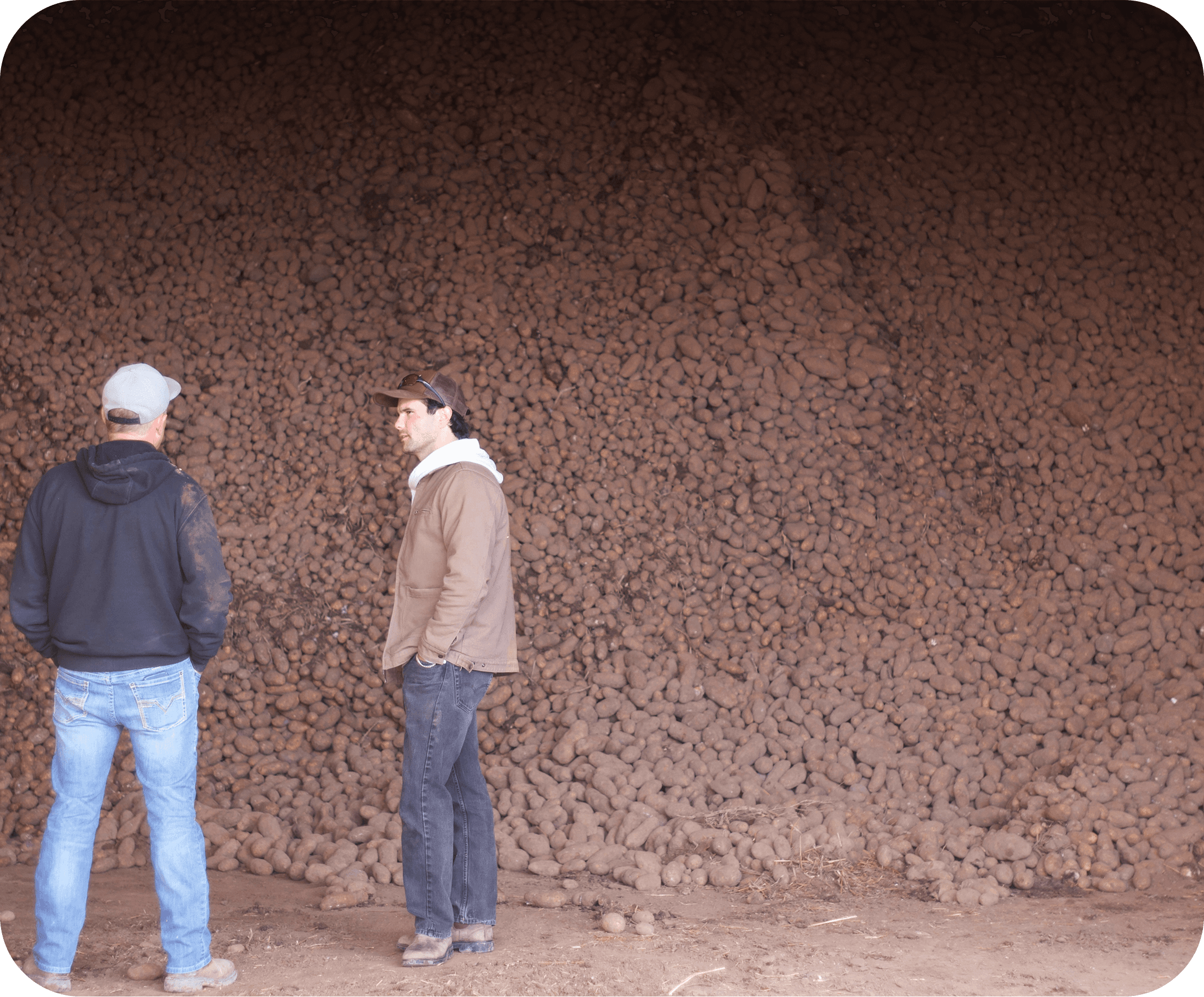
[Idaho Falls, ID] — April 2026 — Last Saturday, standing at an upscale lodge at a ski slope, a baked potato cost me nearly thirty dollars. Just days earlier and a few hour drive away, I stood on top of tens of millions of pounds of unsold potatoes in a farmer's storage shed — all of it headed for the dump.
That contradiction is not an accident. It is a symptom of a deeply broken agricultural system, and the farmers at the center of it have been told, in no uncertain terms, to stay quiet.
Idaho is the undisputed capital of American potato production, producing roughly one-third of all U.S. potatoes World Population Review and ranking number one in the nation for potato output Capital Press. This past season was, by agricultural measures, a success: favorable weather delivered exceptional yields. But a bumper crop has not meant a profitable one. With global buyers now able to source potatoes overseas at a fraction of domestic costs — accelerated by a wave of new international trade agreements, including the UK-India free trade agreement signed in July 2025 House of Commons Library and a US-India interim trade framework announced in February 2026 The White House that expanded agricultural market access on both sides — American farmers are being undercut at the very moment their barns are fullest.
This is not a new crisis. It is the latest and most visible chapter in a long financial unraveling. The U.S. has lost more than 140,000 farms between 2017 and 2022, with an additional 20,000 disappearing in the two years since. American Farm Bureau Federation In 2024, the number of U.S. farms fell to 1.88 million — the lowest count in more than a century. Economic Research Service The 2025 crop year marked negative returns across the board for commodity producers, DTNPf with farmers absorbing rising input costs against plummeting prices — many of them entering their third, fourth, or fifth consecutive year in the red.
Fewer large buyers — major retailers and processors offering large-scale contracts — means more competition among growers for the same business. Because farmers must plan and invest an entire season in advance, that competition requires enormous upfront cost and labor simply to stay in the running, often at a loss. When a global trade shift suddenly makes imported potatoes more economically attractive to buyers, domestic growers are left holding the harvest with nowhere to send it. The result is tens of millions of pounds of already-harvested potatoes with no market — a surplus so large that even cattle farmers, once a reliable outlet for unsellable produce, are no longer buying.
What makes this crisis particularly acute is what farmers are not allowed to say about it.
Farmers often operate under an unspoken code of silence. When surplus becomes public, processors — the middlemen who buy what remains of the marketable crop — use that information to drive down the prices they're willing to pay. Since farmers cannot legally coordinate on pricing, they are left to absorb their losses individually, in private, while the mountains of rotting produce grow larger. It is, by the farmers' own description, a don't-ask, don't-tell system — even as it represents a staggering problem for farm finances, rural communities, and the environment.
The tragedy deepens against the backdrop of what is happening on the other side of this equation. The "One Big Beautiful Bill," signed into law, will cut approximately $186 billion from SNAP funding through 2034 CNBC — the largest reduction to federal food assistance in American history. More than 42 million Americans rely on SNAP to buy food each month, and 70 percent of those participants are elderly, disabled, or children. Harvard Kennedy School Demand for fresh, healthy food in underserved communities has never been higher. The supply to meet it has never been more available — or more endangered.
The farmers themselves are clear about what they'd prefer. "I worked to grow this food," one Idaho grower told us. "I'd much rather see it go to people in need than to cattle or a dump."
That is where The Farmlink Project comes in. Founded during the COVID-19 pandemic by college students who recognized that surplus food and food insecurity existed simultaneously across America, Farmlink operates as a grassroots nonprofit with a simple but powerful model: connect farmers who have more food than they can sell with the charitable food system that desperately needs it — at zero cost to the community. To date, the organization has rescued more than 500 million pounds of fresh, surplus produce and routed it into food banks, schools, churches, and pantries across the country. In Idaho alone, Farmlink has already rescued 120,000 pounds of surplus potatoes, distributing them to communities where demand — and hunger — remain high.
But the scale of the problem far exceeds what any single organization can address alone. The infrastructure to move this food exists. The need for it is undeniable. What is missing is the funding, policy support, and public awareness necessary to make food rescue a permanent, reliable safety net — rather than a stopgap measure deployed crisis by crisis.
The Farmlink Project is calling for greater public, private, and policy resources directed toward the agricultural food rescue system. The goal is not charity. It is common sense: using food that is already grown, already harvested, and otherwise destined for waste, to fight hunger in the United States.
Rotting potatoes are not a secret the industry can afford to keep much longer.